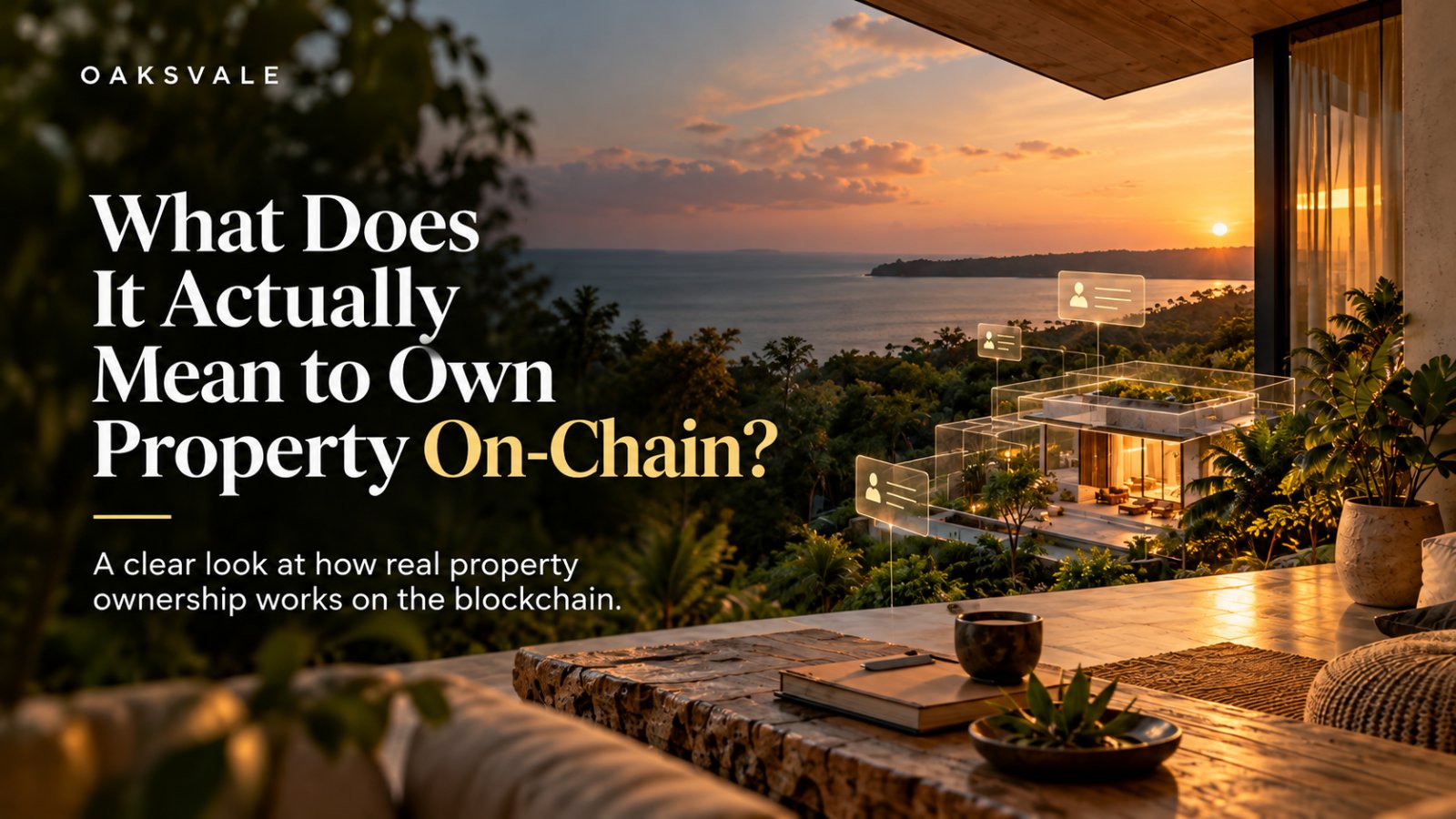
What Does It Actually Mean to Own Property On-Chain?
When people hear that a property is “on-chain”, many picture a house that has somehow moved onto a blockchain. The reality is more useful than that. The property stays exactly where it is, it’s ownership is what is represented on the blockchain.
So what does on-chain ownership actually mean? In short, it is a way to represent and use real world property ownership on to the blockchain. It adds something to ownership. It doesn’t replace it. Here is how that works.
Let’s Go With a Real-World Illustration
Tokenized properties on the Oaksvale Platform are held under a special purpose vehicle, or SPV, a legal entity registered in the country where the properties sit. Under it, each property has its own legal ownership and its own rental business. That is the foundation, and it lives off-chain: in the land registry, in contracts and in company records, the same places ownership has always lived. The blockchain represents it. It doesn’t replace it.
What a property unit is?
Investors co-own a property by holding its units. A property unit is your share of ownership in that property and its rental business, held through the SPV. The more units you hold, the larger your share. Rental income and sale proceeds from that property are shared in proportion to units.
Keep this in mind: a unit is a real right. It exists off-chain, in the documents that govern the SPV and your place in it.
So what is the on-chain part?
Each unit is designed to have an on-chain representation, a digital record of who holds which unit. Think of your banking app. It shows your balance, lets you move money and lets you act on your account. But the account itself is at the bank. Delete the app and your money is still there.
The on-chain representation works in a similar way, with one difference: the record sits on a blockchain, so it is shared, time-stamped and very hard to change quietly. It is how you act on your ownership. It doesn’t create it or replace it.
There are three things you do with it:
- Claim your rental income. Net rental income is shared in proportion to units, and you use your representation to claim your part.
- Take part in decisions. You can create proposals and vote on them.
- Receive your share of the sale proceeds. If the property is sold, the proceeds, after costs, are shared among the unit holders in proportion to their units. Your representation shows what you hold, and so what you receive.
A round table for the owners
The easiest way to picture the voting is a round table meeting of the people who co-own that property. Their decisions are about that property and its rental business. Any unit holder can bring a proposal to the table: a renovation, a change in how the property is run, or the sale of the property. Every unit holder has one vote, and when more vote yes than no, the proposal passes.
A sale proposal carries its price, so anyone who thinks the price is wrong votes no.
The table is on-chain because that keeps the process orderly and transparent. The proposal, the votes and the result are in one place, and the same steps apply every time. But the table doesn’t move a single brick.
From vote to action
So what happens once a proposal passes? The SPV carries it out, in accordance with the law of the country where the property is located.
If the owners vote to renovate, the SPV hires the builder. If they vote to sell, the SPV signs the sale, and the transfer is recorded where the law requires it, in the land registry.The chain records what the owners decided. The SPV and the law make it happen.
What stays the same
- The property is still held under the SPV, with the property ownership and its rental business tied to the investors / co owners.
- Your ownership doesn’t depend on the chain alone. It exists off-chain too.
- Every decision is carried out within the law where the property sits.
- The technology doesn’t change your rights. It changes how easily you can see and use them.
A closing thought
Owning property on-chain doesn’t replace real-world ownership. It sits alongside it. The ownership you hold off-chain stays exactly as it is, with the same law behind it, and the on-chain side adds a clearer way to see it, claim from it, and decide things together with the other owners.
The property stays where the law puts it. The chain gives its owners a table to sit at.