Fractional Property Ownership Explained: Legal Structure and Blockchain
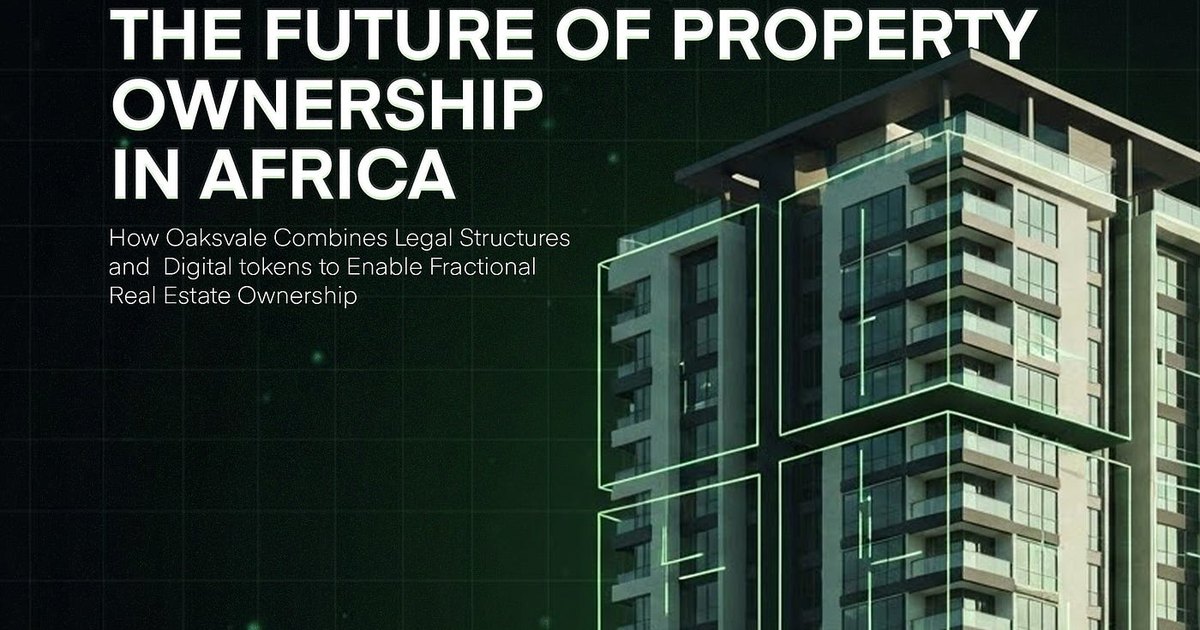
African real estate has always been one of the most powerful paths to wealth creation. Yet for decades it has remained largely inaccessible to the very people most invested in the continent, those who live here, build here, and send money back here. High capital requirements, slow legal processes, and a chronic lack of transparency have created a system where property ownership is concentrated among a narrow few.
Oaksvale was built to challenge that reality. By combining legally structured SPV ownership with blockchain-based fractional participation, Oaksvale is building a new model where Africans, the diaspora, and global investors can co-own income-generating properties transparently, securely, and without needing millions to get started.
This article explains how fractional ownership works on the Oaksvale platform, and how the legal and on-chain layers work together to create genuine trust and accountability.
The Problem With Traditional Property Ownership in Africa
Traditional real estate investment in Africa faces recurring structural challenges. Property prices often grow faster than incomes. Documentation is paper-heavy and slow. Investors rely on intermediaries they may not fully trust. Diaspora investors, in particular, struggle with verification, transparency, and ongoing visibility into how their assets are managed.
At the same time, Africa is experiencing rapid urbanization, tourism growth, and an expanding middle class. Demand for quality short-term hospitality and premium commercial properties continues to rise, yet ownership remains out of reach for most.
The problem is not demand. The problem is access, structure, and trust.
What Fractional Ownership Means on Oaksvale
Fractional ownership on Oaksvale allows multiple verified investors to collectively hold economic rights in a single real-world property, with each investor’s stake proportional to their contribution.
Instead of needing hundreds of thousands of dollars to participate in premium African real estate, an investor can acquire a defined number of ownership units and still earn their share of monthly rental income, benefit from capital appreciation, and participate in property-level governance decisions.
Each property on Oaksvale is curated and onboarded by the platform, not developed by it. Once a property passes Oaksvale’s due diligence and feasibility assessment, it is held under a dedicated Special Purpose Vehicle (SPV), a legally registered entity that owns the asset under applicable local law. The SPV acts as the bridge between on-chain participation and real-world legal ownership.
Investor participation is structured through ownership units, which define each investor’s economic rights in the SPV. These units are recorded on the Ethereum blockchain, creating a permanent, verifiable, and tamper-proof record of ownership.
How the Legal and Blockchain Layers Work Together
A common misconception is that blockchain ownership replaces legal ownership. On Oaksvale, it does not. The two layers work in parallel, each doing something the other cannot.
Legal Layer (Off-Chain) The property is owned by an SPV under local law. Investors who participate in a primary sale are allocated ownership units and economic interests in that SPV based on their contribution. This allocation is backed by legally binding subscription agreements, SPV company records, and registry documentation. The legal layer creates enforceability, if a dispute ever arises, investors have recourse through real-world legal mechanisms.
Blockchain Layer (On-Chain) Each investor’s ownership units are recorded on the Ethereum blockchain. The on-chain record acts as a permanent, publicly verifiable certificate that mirrors the investor’s legal economic rights in the SPV. It is directly linked to the investor’s verified identity, the underlying subscription agreement, and the property’s financial performance.
The on-chain record does not exist in isolation. It only has meaning because it corresponds to a real, enforceable legal interest. And the legal interest only has transparency because the on-chain record makes it publicly verifiable.
This structure ensures that blockchain ownership reflects legal reality, not speculation.
Why Ownership Units Are Recorded On-Chain
Recording ownership units on the Ethereum blockchain solves several long-standing problems in real estate investment.
Verifiability Each ownership unit is permanently recorded and cannot be forged or duplicated. This removes ambiguity around who owns what and eliminates the risk of double-selling that has plagued informal African real estate transactions.
Transparency Ownership history is recorded on-chain, creating a permanent and auditable trail. Every transfer, every distribution, every governance vote is visible, not just to the parties involved, but to the entire DAO community.
Transferability When an investor wants to exit, they can list their ownership units on the Oaksvale Marketplace. The escrow-protected settlement process handles both the on-chain transfer and the corresponding update to the SPV’s legal ownership records, ensuring both layers remain synchronized.
Governance participation Holding ownership units grants the investor voting rights in the Property DAO. Governance votes are cast on-chain, recorded permanently, and executed by Oaksvale’s property management entity in the relevant country.
Income distribution Monthly net profit distributions are calculated pro-rata across all unit holders and disbursed directly to investor wallets in USDC, transparently, without manual intervention from the investors themselves.
In short, the on-chain record provides transparency and efficiency. The legal structure provides enforceability and protection. Neither is sufficient alone.
One Important Clarification on Governance Income
It is worth being clear about how income reaches investors, because this is sometimes misunderstood.
Income distributions are not fully automatic in the sense of requiring no human involvement. Oaksvale’s property management entity in each operating country manages the property, collects rental income, deducts operating expenses and the platform’s distribution fee, calculates each investor’s pro-rata share of the monthly net profit, and initiates the USDC disbursement. The on-chain record of each investor’s units determines their exact entitlement, but the distribution process involves real-world operational steps.
This is not a weakness. It is an honest description of how tokenized real estate actually works, and it is why Oaksvale’s property management infrastructure, established locally in each country where it operates, is a core part of the platform, not an afterthought.
In Conclusion
Oaksvale is not about replacing real estate with crypto. It is about upgrading real estate with technology, and specifically, with the combination of legal structure and on-chain transparency that makes ownership genuinely trustworthy for the first time.
By aligning SPV structures, contract-based ownership, identity verification, on-chain records, governance, and escrow-protected trading, Oaksvale is building the infrastructure for a transparent, scalable, and inclusive real estate ecosystem across Africa.
Fractional ownership is not the future of African real estate. It is the present, and Oaksvale is the infrastructure layer making it possible.
The first Property DAO launches in 2026. Register your interest at https://oaksvale.com/waitlist.
Originally published on Medium.