Why African Real Estate Has a Trust Problem: How Blockchain Solves It
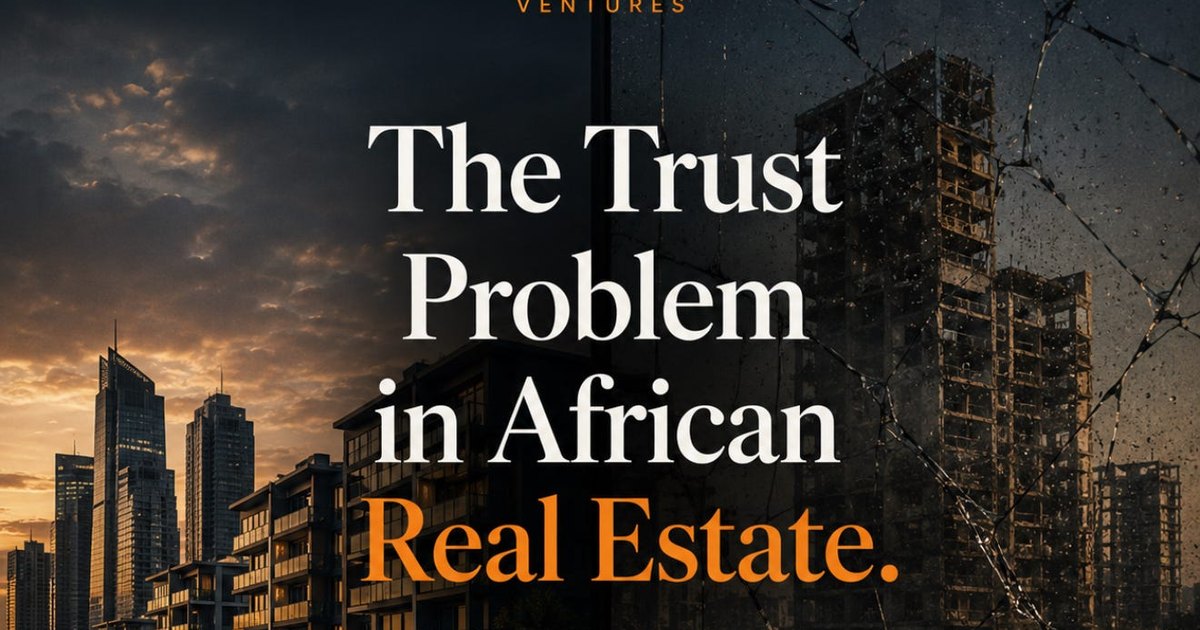
African real estate is one of the most compelling investment opportunities on the planet. The fundamentals are undeniable, rapid urbanization, a young and growing population, expanding middle class, deepening tourism corridors, and a diaspora sending home more than $100 billion every year. By almost every measure of long-term demand, African real estate should be attracting significant global capital.
It isn’t. Not at the scale the fundamentals justify. And the reason is not what most people assume.
The problem is not demand. The problem is not capital. The problem is trust.
The Scale of the Gap
The African Development Bank estimates the continent faces a housing and real estate financing gap exceeding $1.4 trillion annually. Africa’s urban population is expected to double by 2050, creating structural, generational demand for quality real estate across every major category. Premium short-term rentals in tourism corridors like Zanzibar and Diani Beach command yields that developed market investors would consider exceptional. Serviced apartments in Lagos, Nairobi, and Kigali are chronically undersupplied relative to corporate and diplomatic demand.
Yet foreign direct investment into African real estate remains a fraction of what the market size would suggest. Diaspora investors, who collectively represent one of the largest pools of Africa-connected capital in the world, channel the vast majority of their remittances into consumption rather than investment. Not because they don’t want to invest. Because they’ve learned, often through painful personal experience, that the structures don’t protect them.
What the Trust Problem Actually Looks Like
The trust problem in African real estate is not abstract. It has specific, documented, recurring manifestations that have shaped the behavior of an entire generation of potential investors.
Title fraud and disputed ownership
Land title systems across much of Africa remain fragmented, inconsistently maintained, and vulnerable to manipulation. A 2019 survey by the Lagos State government found that over 60% of land transactions in the state involved some form of documentation irregularity. Properties are sold to multiple buyers simultaneously. Titles are forged. Caretakers claim ownership. Family land disputes emerge years after a purchase is completed. The buyer who believed they owned a property discovers their title is one of three competing claims on the same asset.
This is not a marginal problem. It is the documented, recurring experience of investors across Nigeria, Ghana, Kenya, and beyond, and it has permanently shaped the risk calculus of every potential investor who has heard these stories firsthand.
Developer abandonment
The phenomenon of abandoned real estate developments is so widespread across African markets that it has acquired its own informal vocabulary. In Nigeria alone, thousands of housing projects representing billions of dollars in investor capital have been abandoned at various stages of construction. Developers raise capital, often from diaspora investors who wire money from the UK, US, or Canada, and then disappear, delay indefinitely, or deliver a product so far below the promised specification that the investment is effectively worthless.
The pattern is consistent: glossy brochures, persuasive sales agents, a deposit collected, and then silence. The investor has no legal recourse that is realistically actionable across jurisdictions. The money is gone.
Opacity in management and returns
Even where a property is legitimately purchased and professionally managed, the investor’s ability to verify what is actually happening with their asset is severely limited. Rental income reported by managers cannot be independently verified. Occupancy figures are unauditable. Expenses are opaque. The investor receives whatever the manager chooses to report, with no mechanism to challenge it, verify it, or compare it to an independently accessible record.
For diaspora investors managing assets from thousands of miles away, this opacity is not merely inconvenient. It is a structural invitation to exploitation.
Legal recourse that doesn’t work across borders
When things go wrong, and for a significant proportion of diaspora investors in African real estate, they do, the legal recourse available is practically unusable. Pursuing a developer or manager through the Nigerian or Kenyan court system from London or Houston is prohibitively expensive, slow, and uncertain. The investor typically has three options: absorb the loss, engage a local lawyer whose incentives and accountability are unclear, or attempt to navigate an unfamiliar legal system from abroad. Most choose the first option. Developers know this. The absence of credible enforcement is itself an enabler of the behavior it should deter.
The Consequence: Rational Disengagement
The rational response to this environment is exactly what we observe, disengagement. Not because African investors and diaspora don’t want to invest in African real estate. The desire is real, deep, and consistent across every survey and community conversation on the subject. But desire without a trustworthy structure produces frustration rather than investment.
A 2023 study by the African Diaspora Investment Network found that over 70% of diaspora Africans surveyed expressed strong interest in investing in real estate in their countries of origin. The same study found that fewer than 15% had actually done so, and of those who had, nearly a third reported a negative experience involving some form of misrepresentation, disputed ownership, or unreported income.
The gap between desire and action is not a marketing problem. It is a structural problem. The structures that should make investment trustworthy, reliable title systems, enforceable contracts, transparent reporting, accessible recourse, are either absent, weak, or inaccessible to the investors who need them most.
Why Better Marketing Is Not the Answer
The instinct of many real estate platforms operating in Africa has been to treat the trust problem as a marketing challenge. If the right story is told compellingly enough, if the brochures are glossy enough, if the developer’s track record is presented persuasively enough, investors will overcome their hesitation and commit.
This instinct is wrong. And the evidence is clear: a decade of increasingly sophisticated real estate marketing in Africa has not moved the dial on diaspora investment in any meaningful way. The investors who have been burned are not withholding capital because they haven’t heard a good enough pitch. They are withholding capital because the underlying structures have not changed.
Trust is not a marketing problem. It is an infrastructure problem.
The question is not “how do we convince investors that African real estate is safe?” The question is “how do we make African real estate structurally safe, in a way that is verifiable, enforceable, and independent of the character of any individual developer or manager?”
What Structural Trust Actually Requires
Solving the trust problem in African real estate requires changing the architecture of ownership, not the messaging around it. Specifically, it requires four things that traditional real estate structures do not reliably provide.
Legal separation of the asset from the operator
The single most important structural protection for real estate investors is the separation of the asset from the entity operating it. When a property is held by a dedicated Special Purpose Vehicle, a legally registered company whose sole purpose is to hold that specific asset, the investor’s ownership rights survive the failure, fraud, or disappearance of the developer or manager. The SPV exists independently. The property is its only asset. The investor’s rights flow from the SPV, not from their relationship with a developer whose continued goodwill they are dependent on.
This structure, standard in institutional real estate transactions globally, has historically been inaccessible to retail and diaspora investors in African markets because the legal costs of establishing and maintaining SPVs were prohibitive at small investment sizes. Tokenization changes that equation by allowing the costs of SPV establishment and maintenance to be distributed across a community of co-owners.
Verifiable, tamper-proof ownership records
Title fraud is possible in traditional real estate because ownership records are maintained by centralized registries that are vulnerable to manipulation, corruption, and administrative error. Blockchain technology offers a fundamentally different record-keeping architecture, one where ownership is recorded on a public, distributed ledger that no single party controls and no one can alter without detection.
When an investor’s ownership units are recorded on the Ethereum blockchain, linked to their verified identity and corresponding to a legally registered interest in an SPV, the ownership record is permanent, publicly verifiable, and tamper-proof. A fraudulent duplicate title cannot be created because the blockchain record cannot be duplicated without detection. The investor can verify their ownership from anywhere in the world, at any time, without relying on any intermediary.
Transparent, on-chain financial reporting
The opacity of management and returns is solved not by trusting managers to report honestly, but by making dishonest reporting structurally impossible. When every income distribution, every operating expense, and every governance decision is recorded on-chain, visible to every co-owner of the property, the manager cannot report lower occupancy than actually occurred, cannot inflate expenses, and cannot redirect income. The record is public. The discrepancy would be immediately visible.
This level of transparency has no precedent in traditional African real estate investment. It transforms the investor’s relationship with their asset from one of dependence on the manager’s goodwill to one of verifiable, independent oversight.
Accessible liquidity and exit
The final element of structural trust is the ability to exit. An investment with no credible exit pathway is not an investment, it is a commitment of indefinite duration to a counterparty whose behavior the investor cannot control. The illiquidity of traditional African real estate investment is itself a trust problem: it creates an asymmetric power relationship where the developer or manager knows the investor has no practical exit, and can behave accordingly.
A functioning secondary marketplace, where ownership units can be listed for sale to other verified investors, with settlement protected by escrow, changes this power relationship fundamentally. The investor always has an exit pathway. The developer and manager know it. The knowledge of that exit pathway is itself a disciplining force on the behavior of everyone involved.
Oaksvale: Infrastructure for Structural Trust
Oaksvale is built on the conviction that the trust problem in African real estate cannot be solved with better marketing, better brochures, or more persuasive sales agents. It can only be solved by changing the underlying architecture of ownership.
Every design decision in the Oaksvale platform is a direct response to one of the specific failure modes described in this article.
Each property on Oaksvale is held by a dedicated Special Purpose Vehicle registered under local law in the jurisdiction where the property is located. The SPV owns the asset. Investors hold ownership units representing legally enforceable economic rights in that SPV. The SPV exists independently of Oaksvale, meaning that even in the unlikely event of platform failure, the underlying asset and the investors’ legal rights to it survive intact.
Ownership units are recorded on the Ethereum blockchain, permanently, publicly, and tamper-proof, linked to each investor’s verified identity and corresponding to their legal interest in the SPV. The on-chain record and the off-chain legal record are maintained in parallel, each reinforcing and verifying the other.
Every income distribution on Oaksvale is calculated from the property’s actual net profit, gross rental income minus operating expenses, and distributed pro-rata to unit holders in USDC, with a full breakdown of income, expenses, and net profit visible to every co-owner through the platform dashboard. There is no opacity in the reporting. There is nothing to hide because the record is always available.
And when an investor chooses to exit, they list their units on the Oaksvale Marketplace. Their units are immediately locked in escrow, protected and unavailable for manipulation. A buyer commits USDC into the same escrow contract. Oaksvale’s compliance team performs the off-chain legal transfer of beneficial ownership in the SPV. Settlement occurs simultaneously on-chain and off-chain. The seller receives USDC. The buyer receives legally recognized ownership units. Neither party has to trust the other, the structure protects both.
This is not a promise. It is an architecture. And it is the architecture that African real estate has been missing.
The Broader Significance
The trust problem in African real estate is not just an investment problem. It is a wealth problem.
When diaspora capital cannot find a trustworthy path into African real estate, it flows elsewhere, into index funds, into London buy-to-lets, into savings accounts in foreign currencies. The capital that could be building premium hospitality infrastructure in Zanzibar, or serviced apartments in Kigali, or mixed-use commercial developments in Lagos, instead builds wealth in markets that have no shortage of it.
When local African investors cannot trust the structures available to them, the premium real estate market remains the exclusive domain of those with the right connections, the right legal infrastructure, and the right proximity to deal flow. The democratization of ownership that should accompany economic development never happens.
Solving the trust problem does not just unlock investment returns for individual investors. It redirects significant pools of capital toward the African markets where they would have the greatest economic impact, funding development, creating employment, and building the premium real estate infrastructure that Africa’s rapidly growing urban population will demand.
That is the significance of getting this right. And it is why the infrastructure being built to solve it matters beyond the returns it generates for any individual investor.
Conclusion
African real estate does not have a demand problem. It does not have a capital problem. It has a trust problem, specific, structural, and solvable.
The solution is not better marketing. It is better infrastructure. Legal structures that separate assets from operators. Ownership records that cannot be tampered with. Financial reporting that cannot be manipulated. Exit pathways that give investors genuine liquidity.
When those structural conditions exist, when trust is built into the architecture rather than promised in the brochure, the capital that has been waiting on the sidelines will move. The diaspora investor who was burned will return. The local professional who never had access will participate. The global investor who dismissed African real estate as too risky will reconsider.
The first Property DAO launches in 2026. Register your interest at https://oaksvale.com/waitlist.
Originally published on Medium.